The T-Shaped Person: Mastering the Art of Being Both Specialist and Generalist
The T-Shaped Person: Mastering the Art of Being Both Specialist and Generalist
Why it's important to be both a strong generalist and strong specialist
By Test1 User1
•• 29 views
The T-Shaped Person: Mastering the Art of Being Both Specialist and Generalist
In today's rapidly evolving professional landscape, the question isn't whether you should be a specialist or a generalist—it's how to become both. Enter the concept of the "T-shaped person," a framework that has revolutionized how we think about skill development, career growth, and professional value creation.
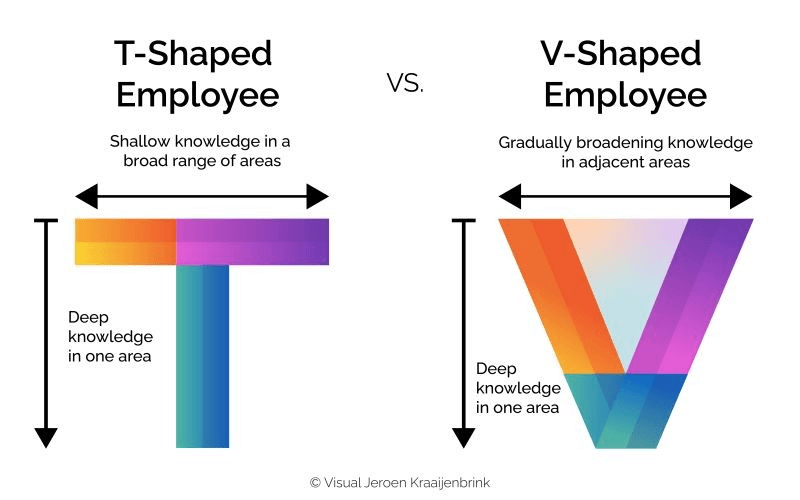
The T-shaped person model, popularized by design consultancy IDEO and widely adopted across industries, represents professionals who combine deep expertise in one area with broad knowledge across multiple disciplines. Like the letter "T," these individuals have a vertical stroke representing their specialized knowledge and a horizontal stroke symbolizing their ability to collaborate and contribute across various fields.
But why has this concept gained such traction? And more importantly, how can you develop into a T-shaped professional yourself?
Understanding the Anatomy of the T
The Vertical Stroke: Your Deep Specialization
The vertical line of the T represents your core expertise—the domain where you've developed deep, specialized knowledge that sets you apart from others. This isn't just about having a job title or completing a degree; it's about achieving mastery that others recognize and seek out.
This specialization might be technical (software engineering, data science, molecular biology), creative (graphic design, copywriting, filmmaking), or strategic (market analysis, organizational psychology, financial modeling). The key is that you've invested significant time and effort to develop expertise that goes well beyond surface-level understanding.
Deep specialists bring irreplaceable value to organizations. They can solve complex problems that others cannot, identify nuances that generalists might miss, and push the boundaries of what's possible in their field. They're the ones teams turn to when facing their most challenging technical, creative, or strategic obstacles.
However, specialization alone has its limitations. In our interconnected world, pure specialists often find themselves isolated, unable to translate their expertise into broader organizational impact or struggling to adapt when their specific field evolves rapidly.
The Horizontal Stroke: Your Collaborative Breadth
The horizontal stroke represents your ability to work across disciplines, communicate with diverse teams, and apply insights from multiple fields to solve complex problems. This isn't about being a jack-of-all-trades, but rather about developing enough understanding in adjacent areas to be an effective collaborator and bridge-builder.
Cross-functional literacy: Understanding enough about marketing, finance, operations, technology, and other business functions to communicate effectively with colleagues from these areas.
Industry awareness: Staying informed about trends, challenges, and opportunities beyond your immediate specialization that might impact your work or organization.
Methodological flexibility: Being comfortable with different problem-solving approaches, whether they come from design thinking, agile development, lean startup methodology, or scientific research.
Cultural competence: Ability to work effectively with people from different backgrounds, departments, and perspectives.
The horizontal stroke enables specialists to amplify their impact by connecting their expertise to broader organizational goals and collaborating effectively with diverse teams.
Why the T-Shape Matters More Than Ever
The Complexity of Modern Challenges
Today's most pressing problems—climate change, digital transformation, healthcare innovation, social equity—don't fit neatly into single disciplines. They require teams that can integrate insights from multiple fields while maintaining deep expertise in specific areas.
Consider the development of a new medical device. Success requires deep technical expertise in engineering and materials science, but also understanding of regulatory requirements, user experience design, manufacturing processes, market dynamics, and healthcare delivery systems. No single person can be expert in all these areas, but T-shaped team members can bridge these domains effectively.
The Speed of Change
Industries are evolving at an unprecedented pace. Pure specialists risk becoming obsolete if their narrow field becomes automated or irrelevant. T-shaped professionals, with their broader perspective and collaborative skills, are better positioned to adapt their expertise to new contexts and opportunities.
The Premium on Innovation
Innovation increasingly happens at the intersection of disciplines. The most breakthrough ideas often come from applying insights from one field to challenges in another. T-shaped professionals are uniquely positioned to spot these cross-pollination opportunities.
The Rise of Remote and Distributed Work
As teams become more distributed and diverse, the ability to communicate across different backgrounds and work styles becomes increasingly valuable. T-shaped professionals excel in these environments because they can translate between different perspectives and find common ground.
Building Your T-Shape: A Strategic Approach
Deepening the Vertical
Choose your specialization wisely: Your deep expertise should align with your natural strengths, genuine interests, and market opportunities. Look for areas where demand is likely to remain strong or grow over time.
Pursue deliberate practice: Move beyond just doing your job to actively seeking challenges that push your skills forward. Seek feedback, study masters in your field, and continuously raise your standards.
Stay current: Deep expertise requires ongoing investment. Follow thought leaders, attend conferences, read research, and engage with the cutting edge of your field.
Teach others: Nothing deepens understanding like explaining complex concepts to others. Mentor colleagues, write about your expertise, or speak at industry events.
Expanding the Horizontal
Develop adjacent skills: Start with areas that directly support your specialization. A software engineer might study user experience design, project management, or business strategy.
Join cross-functional projects: Volunteer for initiatives that require collaboration with different departments or disciplines. These experiences provide natural opportunities to understand other perspectives.
Read broadly: Consume content outside your field. Read business books, follow industry publications from adjacent sectors, and stay informed about general technology and social trends.
Build relationships: Cultivate relationships with colleagues from different backgrounds. These connections provide informal learning opportunities and potential collaboration partners.
Practice translation: Work on explaining your specialized knowledge in terms that non-specialists can understand. This skill is crucial for effective collaboration.
T-Shaped Teams and Organizations
The Power of Diverse T-Shapes
The most effective teams consist of multiple T-shaped individuals with different vertical specializations but overlapping horizontal knowledge. This creates what researchers call "cognitive diversity"—teams that can approach problems from multiple angles while maintaining deep expertise in key areas.
Organizational Culture
Organizations that want to develop T-shaped professionals must create cultures that reward both deep expertise and collaborative behavior. This means:
Recognizing and rewarding cross-functional collaboration
Providing opportunities for employees to work outside their primary areas
Encouraging knowledge sharing and internal mobility
Investing in both technical training and soft skills development
Common Pitfalls and How to Avoid Them
The Shallow T Trap
Some professionals develop broad but superficial knowledge without building genuine expertise anywhere. This creates an inverted T—lots of surface knowledge but no deep value. Combat this by ensuring your vertical stroke remains your primary focus and competitive advantage.
The Narrow T Problem
Others develop deep expertise but remain siloed, unable to collaborate effectively or translate their knowledge into broader impact. Actively seek opportunities to work with other disciplines and practice communicating your expertise to diverse audiences.
The Shape-Shifting Mistake
Trying to be everything to everyone leads to confusion and ineffectiveness. Your T-shape should evolve thoughtfully over time, not change dramatically with every new trend or opportunity.
Industry Examples and Applications
Technology Sector
In tech companies, the most valuable engineers often combine deep technical skills with understanding of user needs, business models, and market dynamics. They can build technically excellent solutions that also serve real user needs and business objectives.
Healthcare
Modern healthcare professionals increasingly need T-shaped skills. A surgeon with deep technical expertise who also understands healthcare economics, patient communication, and healthcare technology can drive improvements far beyond the operating room.
Consulting
Management consultants exemplify the T-shaped model, combining deep expertise in specific industries or functional areas with broad business knowledge and problem-solving methodologies that apply across contexts.
Creative Industries
Successful designers, writers, and other creative professionals often combine artistic expertise with understanding of business strategy, technology trends, and audience psychology.
The Future of T-Shaped Professionals
As artificial intelligence and automation continue to evolve, the value of T-shaped professionals is likely to increase. While AI may automate routine specialist tasks, the ability to integrate knowledge across domains, collaborate effectively, and apply expertise to novel contexts remains distinctly human.
The professionals who thrive in the coming decades will be those who can combine irreplaceable deep expertise with the collaborative and integrative skills that define the horizontal stroke of the T.
Building Your Personal Development Plan
Assessment
Start by honestly assessing your current T-shape:
Where is your deep expertise strongest?
What adjacent areas would complement your specialization?
Where are the biggest gaps in your horizontal knowledge?
What collaboration skills need development?
Goal Setting
Set specific goals for both vertical and horizontal development:
What new level of expertise do you want to achieve in your specialization?
Which 2-3 adjacent areas would most benefit your career and impact?
What collaboration opportunities will you seek out?
Action Planning
Create concrete plans with timelines:
Year 1-2: Focus 70% on deepening core expertise, 30% on developing 1-2 adjacent skills
Year 3-5: Maintain expertise while expanding to 2-3 adjacent areas and taking on cross-functional leadership roles
Year 5+: Achieve recognized expertise in core area while serving as bridge between disciplines
How will you deepen your expertise? (Courses, projects, mentors)
How will you expand your breadth? (Cross-functional work, reading, networking)
How will you measure progress in both dimensions?
Research by Deloitte shows that professionals who follow structured T-shaped development plans over 5+ years earn 35% more and are promoted 50% faster than those who develop skills randomly.
Conclusion: The Balanced Professional
The T-shaped person concept offers a powerful framework for professional development in our complex, interconnected world. By combining deep specialization with broad collaborative skills, T-shaped professionals can create exceptional value while remaining adaptable and relevant.
The goal isn't to become equally expert in everything—that's impossible and unnecessary. Instead, it's about building a foundation of deep expertise while developing the knowledge and skills needed to collaborate effectively, communicate across disciplines, and apply your expertise to diverse challenges.
In a world that increasingly rewards both depth and breadth, the T-shaped professional represents not just a career strategy, but a mindset—one that values both mastery and connection, expertise and empathy, specialization and synthesis.
Whether you're just starting your career or looking to evolve your professional impact, developing your T-shape isn't just an investment in your future success—it's a pathway to becoming the kind of professional who can tackle complex challenges and create meaningful change in our rapidly evolving world.
The question isn't whether you can afford to become T-shaped. In today's professional landscape, the question is whether you can afford not to.